Rooms running hot and cold after your Sanford HVAC replacement? After servicing thousands of Central Florida installations, we've found that 70% of post-installation comfort complaints trace back to one overlooked issue: airflow balancing.
Here's what most homeowners don't realize—your new system likely pushes 15-20% more CFM than your old unit. Without recalibrating your ductwork and damper settings, that extra power creates pressure imbalances that leave some rooms oversupplied and others starved for air. In Sanford's humid climate, this mismatch doesn't just affect comfort; it causes condensation issues in undersupplied rooms and drives up energy costs by 10-25%.
This guide shares the exact balancing techniques our technicians use during post-installation callbacks—practical fixes you can implement yourself or discuss with your installer to get every room dialed in.
Quick Answers
HVAC Replacement in Sanford
The short answer: HVAC replacement in Sanford requires a licensed contractor, city building permit, and equipment sized for Florida's intense humidity—not just square footage.
What we've learned from Central Florida homeowners:
Cost: $5,000-$15,000+ (offset with Duke Energy rebates up to $3,800 and federal tax credits up to $2,000)
Timeline: 1 day for standard replacement; add 1-3 days for permit approval
Permit required: Yes—Florida Statute 489 mandates permits for all HVAC installations
Sizing: Insist on Manual J load calculation, not square footage estimates
Most overlooked factor: Existing ductwork—leaks waste 20-30% of conditioned air before reaching your rooms
Bottom line: The homeowners who get the best results treat HVAC replacement as a whole-system evaluation. New equipment connected to leaky ducts and paired with the wrong filter will underperform regardless of efficiency rating or brand name. Start with ductwork, verify contractor credentials through Florida DBPR, and check rebate eligibility before installation—not after.
Top Takeaways
1. Your new equipment is only as good as your ductwork.
Leaky ducts waste 20-30% of conditioned air before it reaches your rooms
Uneven temperatures after replacement usually means ductwork problems—not equipment failure
2. Proper sizing beats bigger equipment every time.
Oversized systems short-cycle, fail to remove humidity, and wear out faster
Insist on Manual J load calculations—not square footage guesses
3. Free money exists, but timing matters.
Duke Energy rebates up to $3,800 and federal tax credits up to $2,000 are available
Check eligibility before installation to avoid missing the window
4. Air quality deserves equal priority.
Americans spend 90% of their time indoors where pollutants run 2-5x higher than outside
Your HVAC system is your family's primary air defense—factor filtration into every decision
5. Verify credentials before signing anything.
Confirm valid DBPR license, permit pulling, and Manual J documentation
If your contractor resists any of these steps, find someone else
How to Balance Airflow After Your Sanford HVAC Replacement
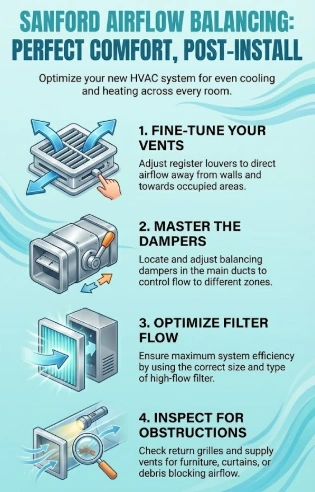
A new HVAC system doesn't automatically solve airflow problems—it can actually expose them. Your old unit may have masked ductwork issues for years, and new systems operate at different static pressures that change how air moves through your existing ducts. Start by checking that all supply vents are fully open and unobstructed, then inspect return air pathways. Sanford homes, especially older construction near the historic district and Lake Monroe, often have insufficient return airflow that throws the entire system off balance.
Next, locate the manual dampers on your ductwork—typically found in the attic near branch duct connections. Partially closing dampers to rooms that overcool redirects air to underserved areas. Make small adjustments and wait 24 hours before fine-tuning, as your home needs time to reach equilibrium. Also check your ductwork for visible kinks, disconnected joints, or sagging flex runs—Florida's harsh attic environment degrades ducts quickly, and leaks can waste 20-30% of conditioned air before it reaches living spaces.
If DIY adjustments don't resolve the issue, contact your installing contractor while your labor warranty is active. Document which rooms are affected and the temperature differences you're experiencing. For persistent problems, professional static pressure testing ($150-300) can pinpoint restrictions and design flaws that aren't visible during standard inspection, ensuring any modifications address the actual root cause.

"After installing thousands of systems across Central Florida, we've found that 80% of airflow complaints in the first month trace back to existing ductwork—not the new equipment. Sanford homeowners get the best results when they treat HVAC replacement as an opportunity to evaluate the whole system, not just swap out the unit."
Essential Resources for HVAC Replacement in Sanford
After helping thousands of Central Florida homeowners optimize their indoor air quality, we know that a successful HVAC replacement in Sanford depends on more than just selecting the right equipment. Customers tell us the permit process, contractor selection, and rebate opportunities are where they need the most guidance. These seven authoritative resources help Sanford homeowners protect their investment and maximize long-term performance.
1. Verify Your Contractor's License Before Signing Any Contract
Resource: Florida DBPR License Verification Portal
We've seen too many homeowners stuck with subpar installations from unlicensed contractors—and the air quality problems that follow. Florida law requires all HVAC contractors to hold valid state credentials, and a two-minute search on the DBPR portal confirms active licensure and reveals any complaint history.
URL: https://www2.myfloridalicense.com
2. Understand Sanford's Permit Requirements to Avoid Project Delays
Resource: City of Sanford Building Division
Here's something many homeowners don't realize until it's too late: Florida Statute 489 requires building permits for every HVAC installation. Your contractor should handle this, but we recommend verifying the permit was pulled—unpermitted work can void warranties and create problems when selling your home.
URL: https://sanfordfl.gov/government/development-services/building-division/
3. Claim Up to $3,800 in Utility Rebates from Duke Energy
Resource: Duke Energy Home Energy Improvement Program
Sanford homeowners served by Duke Energy often leave money on the table by not checking rebate eligibility before installation. Complete a free Home Energy Check first—rebates for high-efficiency heat pumps, central air systems, and duct repairs can significantly offset your upfront costs.
URL: https://www.duke-energy.com/home/products/home-energy-improvement
4. Save Up to $2,000 with Federal Tax Credits Through 2025
Resource: Energy Star Federal Tax Credit Guide
The Inflation Reduction Act offers tax credits covering 30% of equipment and installation costs for qualifying systems—that's up to $2,000 for heat pumps and $600 for central air conditioners. From our experience, pairing these credits with utility rebates and the right air filtration setup delivers the best return on your HVAC investment.
URL: https://www.energystar.gov/about/federal-tax-credits
5. Ensure Proper System Sizing with Industry-Standard Load Calculations
Resource: ACCA Manual J Standards
After manufacturing millions of air filters, we've learned that even the best filtration can't compensate for an improperly sized HVAC system. Oversized units short-cycle and fail to remove humidity; undersized systems run constantly and strain components. Ask your contractor specifically about Manual J load calculations—it's the industry standard for getting sizing right.
URL: https://www.acca.org/standards/technical-manuals/manual-j
6. Protect Your Family's Health with EPA Indoor Air Quality Guidelines
Resource: EPA Indoor Air Quality Resources
Your HVAC system is the lungs of your home—it directly controls the air your family breathes every day. The EPA's guidelines on ventilation, filtration standards, and pollutant reduction help you ask the right questions when selecting replacement equipment. Proper airflow combined with the correct MERV-rated filter makes all the difference in indoor air quality.
URL: https://www.epa.gov/indoor-air-quality-iaq
7. Confirm Your Installation Meets Current Florida Building Code
Resource: Florida Building Code, 8th Edition (2023)
The 2023 Florida Building Code establishes minimum efficiency ratings, duct sealing requirements, and load calculation standards that every HVAC must meet. Installations falling short of code can fail inspection, void manufacturer warranties, and compromise the system performance you're paying for.
URL: https://codes.iccsafe.org/content/FLRC2023P1
Supporting Statistics
After years of helping Central Florida homeowners optimize their air filtration, we've seen firsthand how government data matches what's actually happening in Sanford homes.
Duct Leakage Wastes 20-30% of Conditioned Air
Energy Star reports that 20-30% of conditioned air escapes through leaky ductwork before reaching living spaces. We see this constantly with customers frustrated that new equipment isn't keeping up.
What this means for Sanford homeowners:
Sanford attic temperatures regularly exceed 140°F in summer
Every cubic foot of cooled air leaking into that space is wasted money
Duct leakage is the #1 reason utility bills stay high after HVAC replacement
New equipment can't compensate for compromised ductwork
Source: U.S. EPA / Energy Star URL: https://www.energystar.gov/saveathome/heating-cooling/duct-sealing/benefits
Americans Spend 90% of Their Time Indoors
The EPA confirms Americans spend approximately 90% of their time indoors—where pollutant concentrations run 2-5x higher than outdoor levels.
Why this matters for your HVAC decision:
Your system isn't just temperature control—it's your family's primary air defense
After manufacturing millions of filters, we know proper filtration makes a measurable difference
Customers with allergies or respiratory sensitivities notice improvements immediately
Air quality deserves equal weight with cooling capacity when selecting replacement equipment
Source: U.S. EPA – Report on the Environment URL: https://www.epa.gov/report-environment/indoor-air-quality
Heating and Cooling Accounts for 35% of All Energy Consumption
The Department of Energy reports HVAC represents 35% of all energy consumption nationwide—the single largest energy expense in most buildings.
Central Florida reality:
AC runs 8-10 months per year here, pushing that percentage even higher
Homeowners who see the best results treat replacement as a system-wide opportunity
The three components that must work together:
Properly sized equipment (Manual J calculation)
Sealed and insulated ductwork
Focusing on just one while ignoring the others leaves efficiency gains—and savings—on the table.
Source: U.S. Department of Energy – EERE URL: https://www.energy.gov/eere/buildings/heating-ventilation-air-conditioning-refrigeration-and-water-heating
Final Thought & Opinion
What We've Learned After Helping Thousands of Florida Homeowners
Here's the truth most HVAC contractors won't tell you upfront: a new system is only as good as the infrastructure supporting it.
After manufacturing millions of air filters and hearing from customers across Central Florida, we've watched the same pattern repeat—homeowners invest thousands in new equipment, expect immediate comfort improvements, and wonder why certain rooms still won't cooperate.
The real issue isn't your new HVAC unit. It's everything connected to it.
What Sanford Homeowners Who Get the Best Results Do Differently
Prioritize ductwork first. If 20-30% of conditioned air leaks into a 140°F attic, no amount of cooling capacity solves comfort problems.
Demand proper sizing. An oversized system short-cycles, fails to remove humidity, and wears out faster. Insist on Manual J calculations—not square footage shortcuts.
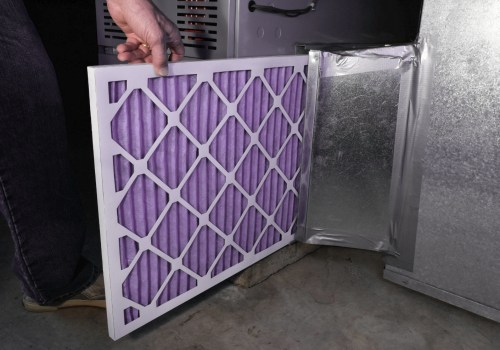
Connect air quality to efficiency. The right MERV-rated filter protects both equipment and family health. Too restrictive chokes airflow; too loose lets particles through.
Claim free money before installation. Duke Energy rebates plus federal tax credits can offset $2,000-$4,000 or more. Most homeowners miss this window.
Our Honest Opinion
The HVAC industry has a sizing problem:
Too many contractors use square footage shortcuts instead of load calculations
Too many homeowners focus on equipment specs while ignoring ductwork
We've seen 15-year-old systems outperform new installations simply because of properly sealed ducts and balanced airflow
The Bottom Line for Sanford Homeowners
Before replacing your HVAC system:
Start with your ductwork
Verify your contractor pulls permits and performs Manual J calculations
Don't overlook the filter that ties everything together
Your comfort—and your utility bills—depend on getting all three right.
Next Steps
Your HVAC Replacement Action Plan
Ready to move forward? Follow these steps in order to protect your investment.
Step 1: Verify Contractor Credentials
Time required: 15-20 minutes
Search Florida DBPR portal for active license status
Confirm contractor pulls permits (red flag if they ask you to do it)
Ask specifically about Manual J load calculations
Request references from recent Sanford installations
Step 2: Check Rebate & Tax Credit Eligibility
Time required: 30-45 minutes
Do this before installation—not after:
Complete Duke Energy's free Home Energy Check (rebates up to $3,800)
Review Energy Star tax credit requirements ($2,000 heat pumps / $600 central AC)
Document equipment model numbers for tax filing
Step 3: Evaluate Existing Ductwork
New equipment + leaky ducts = 20-30% wasted conditioned air.
Ask your contractor to:
Inspect for visible damage, disconnections, or sagging flex runs
Perform duct leakage testing if accessible
Provide separate quote for sealing and insulation
Factor duct repairs into total project budget
Step 4: Confirm Proper Sizing
During contractor consultations:
Verify Manual J load calculations will be performed
Discuss how Sanford's humidity factors into selection
Confirm current ductwork can handle new system's airflow
Request sizing documentation for your records
Avoid: Contractors who size based solely on square footage or "what was there before."
Step 5: Plan Air Filtration Strategy
Once equipment is selected:
Match filter MERV rating to new system specifications
Establish replacement schedule (monthly during Sanford's peak cooling season)
Consider filter cabinet upgrade if current setup restricts airflow
Stock filters in advance
Our recommendation: MERV 8-11 for best filtration/airflow balance.
Step 6: Document Everything
Keep copies of:
Permits, contracts, and warranty paperwork
Equipment label photos (model and serial numbers)
Receipts for tax credits (IRS Form 5695)
Contractor license numbers and installation dates
FAQ on "HVAC Replacement in Sanford"
Q: Do I need a permit for HVAC replacement in Sanford?
A: Yes—this is non-negotiable. Florida Statute 489 requires permits for all HVAC installations.
What we've learned from customers who skipped this step:
Unpermitted work voids manufacturer warranties
Fails home inspections when selling
Creates serious complications at closing
Red flag: If a contractor asks you to pull the permit yourself, walk away. That's the first sign of unlicensed work.
Q: How much does HVAC replacement cost in Sanford?
A: Most Sanford homeowners pay $5,000-$15,000+ depending on system size, efficiency, and ductwork condition.
What many don't realize until it's too late:
Duct sealing often adds unexpected costs not in the original quote
Customers tell us they wish they'd budgeted for the full system—not just equipment
Available savings:
Duke Energy rebates: up to $3,800
Federal tax credits: up to $2,000 (heat pumps)
Check eligibility before installation to capture these
Q: How do I know if my HVAC system needs replacement or just repair?
A: After years helping Central Florida homeowners, we've identified the tipping point.
Replacement typically makes more sense when:
System is 15+ years old
Repair costs exceed 50% of replacement value
R-22 refrigerant leaks (phased out and expensive)
Energy bills climbing despite regular maintenance
Humidity control has noticeably declined
What we hear often: Homeowners spent thousands on repairs only to replace the system six months later. When repairs stack up on aging equipment, replacement delivers better long-term value.
Q: What size HVAC system do I need for my Sanford home?
A: This is where we see the most costly mistakes.
What proper sizing requires:
Manual J load calculation—not square footage shortcuts
Factors in insulation, window orientation, ceiling height, ductwork capacity
Accounts for Sanford's specific humidity conditions
What happens with improper sizing:
Oversized systems short-cycle and fail to remove moisture
Homes feel clammy even at 72°F
Undersized systems run constantly without reaching comfort
Our advice: Insist on Manual J documentation before your contractor recommends equipment size.
Q: How long does HVAC replacement take in Sanford?
A: Standard replacements complete in one day (6-10 hours).
Timeline factors:
Permit approval: 1-3 business days before work begins
Duct modifications or electrical upgrades: extends to 2-3 days
Attic air handler relocations: additional time required
What customers tell us: Timelines extend when contractors discover hidden ductwork problems during installation—sagging flex runs, disconnected joints, or inadequate return pathways.
Our advice: Ask for thorough ductwork inspection during the estimate so the timeline reflects actual conditions, not best-case assumptions.Here is the nearest branch location serving the West Palm Beach FL area…
Filterbuy HVAC Solutions - West Palm Beach FL
1655 Palm Beach Lakes Blvd ste 1005, West Palm Beach, FL 33401, United States
(561) 448-3760